
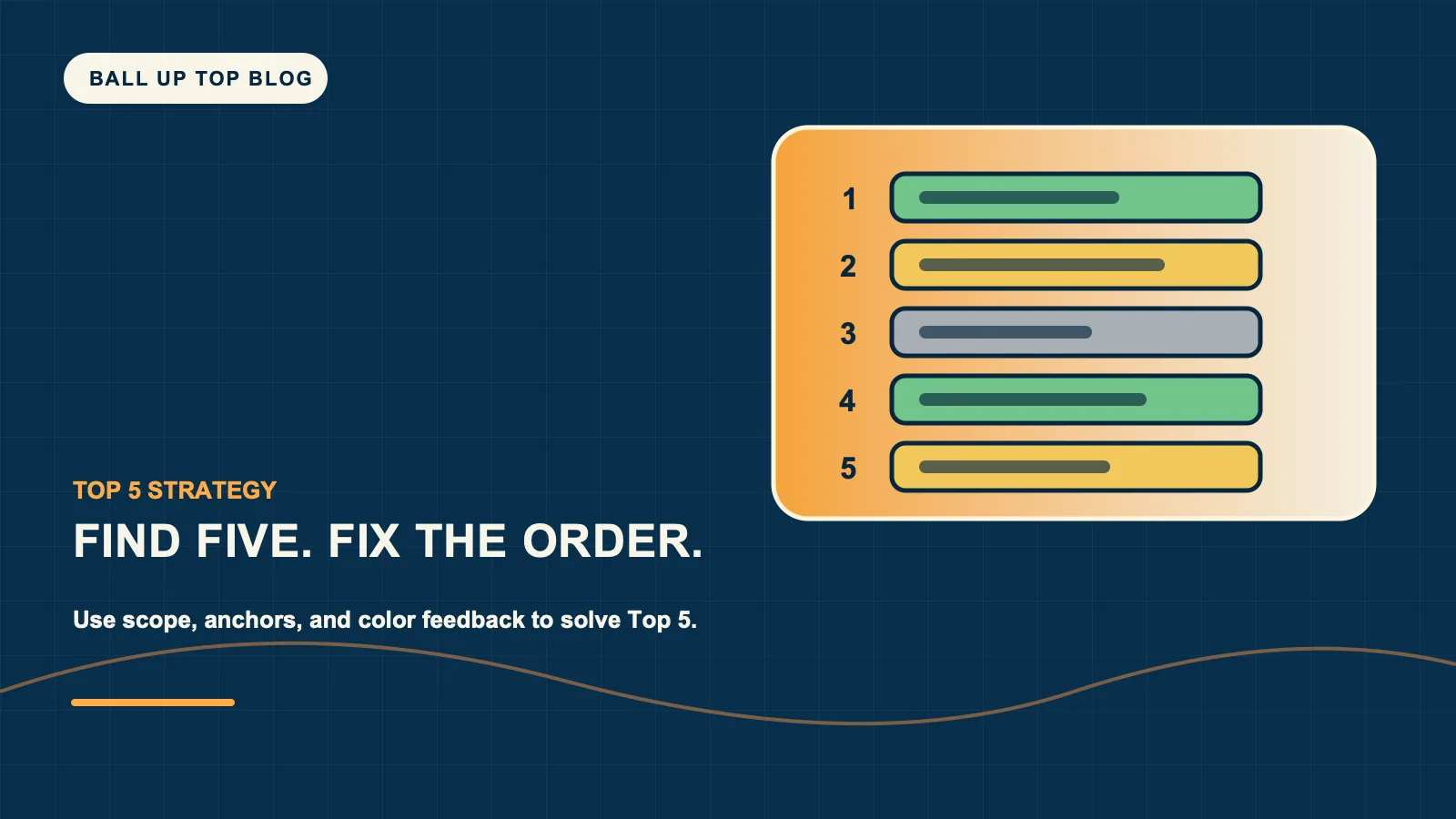
Top 5 asks two questions at once: Which five options belong, and what is their exact order? Trying to solve both in one mental leap makes a difficult list feel chaotic. A better method separates the tasks, uses each color as evidence, and changes only what the previous submission disproved.
You can play from the Top 5 game page. The puzzle gives one prompt, five ordered answer slots, and an option pool capped at 20 choices. You tap five answers in order and receive up to five submissions. Exact order is required to win.
For league-specific records, eras, and franchise context, browse the NBA trivia hub or NFL trivia hub.
Define the ranking before choosing names
Read the scope literally. Is the list based on career totals or one season? Regular season or postseason? One franchise, one league, one position, one era, or the full sport? Is the prompt asking for a count, percentage, date, or ordered achievement?
Write the definition in your own words before selecting. That sentence is your filter. A legendary athlete can be a poor choice if the prompt uses a narrower statistic, and a less famous option can be correct because it fits the exact period or competition.
Watch for look-alike lists: playoff leaders versus regular-season leaders, single-season records versus career totals, franchise rankings versus league rankings, or active-player lists versus all-time lists. Many tempting distractors are strong answers to a nearby question rather than the one on screen.
Build the five before perfecting the order
Start with membership. Identify the options you believe belong somewhere in the top five, even if their internal order is uncertain. Anchor the set with the strongest inclusion—an option you would be surprised to see outside the list—and then test the boundary between fifth place and the best distractor.
Do not spend too long debating third versus fourth while one of your five may not belong at all. The middle order becomes easier after the membership is stable. When two options are close, compare them directly on the prompt’s statistic instead of comparing both to the entire field.
Era context can help generate hypotheses, but it is not proof. Schedule length, rule changes, expansion, career length, and style of play can influence totals. Use those factors to ask better questions, then return to the exact ranking definition.
Read every color as a separate instruction
After a submission, Top 5 marks each selected answer:
- Green: the answer is in the correct slot.
- Yellow: the answer belongs in the five but is in the wrong slot.
- Gray: the answer does not belong in the five.
Lock green answers mentally and avoid moving them without a compelling reason. Keep yellow answers in the set but move them to different positions. Replace gray answers before fine-tuning the remaining order. This prevents the common mistake of discarding a correct member merely because its position was wrong.
Treat the colors as constraints on the next list. If two yellow answers remain and only two open slots are plausible, compare that pair. If a gray answer occupied fifth, reconsider the membership boundary rather than rearranging all five slots.
Make each submission answer a question
You have up to five submissions, so avoid repeating a list that tests nothing new. Before submitting, identify what the arrangement will teach you: whether a new option belongs, whether two yellow entries should swap, or whether an uncertain anchor is truly first.
Rebuild the next five with the smallest conceptual change needed to test that idea. Preserve green answers in the same positions, relocate yellow answers, and replace gray choices. Large reshuffles make it harder to isolate what each change taught you.
The game is tap-to-order, not drag-and-drop. If an answer lands in the wrong slot, remove it and rebuild the sequence, then review all five slots before submitting. The complete rules are covered in How to Play Top 5.
Understand the result without overreading it
Solving on submissions one through five stores scores of 5, 4, 3, 2, or 1. If the exact order is not solved, the stored score is 0. The result reveals the correct ordered five, which makes the final review as valuable as the solve itself.
Compare your last list with the reveal in two stages: membership errors first, ordering errors second. For each miss, write the scope detail that separated the correct answer from your choice. That creates a reusable fact instead of a vague memory that the ranking was difficult.
Top 5 appears in the ranked section, but its 5-to-0 puzzle score records how quickly you found the exact order; it is not a direct reading of overall sports knowledge. Use the score and reveal to diagnose this puzzle, then see What Is Ball IQ? for the separate rating system and its current status.