The NBA rewards fans who notice more than the final score. A useful trivia foundation connects franchises, players, coaches, awards, playoff rounds, draft classes, and the changing language of basketball. This hub brings those connections together without depending on a temporary standings table or one campaign. It is a starting point for learning the league’s structure, revisiting durable history, and choosing a Ball Up Top game that fits the way you like to think.
You do not need encyclopedic recall to enjoy NBA trivia. Strong play often begins with a few reliable anchors: a franchise’s cities and nicknames, the positions and roles associated with important players, the order of major career stops, and the difference between regular-season and postseason achievements. From those anchors, you can reason through unfamiliar prompts instead of treating every question as an isolated fact.
Build an NBA knowledge map
Start with the league as a set of relationships. Teams belong to conferences and divisions, but their histories also include relocations, name changes, expansion eras, and long-running rivalries. A clue about a city may point toward several franchises, while a clue about a retired number, championship run, or famous teammate can narrow the field. Learning those relationships creates a reusable map rather than a pile of disconnected answers.
Players add another layer. Career paths can connect a lottery pick to a veteran role, an All-Star appearance to a later championship, or a signature skill to a specific era. Positions are helpful labels, not complete descriptions: many guards initiate offense, many forwards handle the ball, and defensive assignments often cross traditional categories. Good trivia respects that complexity by using precise achievements, seasons, teams, and roles instead of assuming every player fits one simple box.
Awards and statistical milestones are most useful when you understand what they measure. Most Valuable Player, Rookie of the Year, Defensive Player of the Year, Sixth Man of the Year, and All-NBA selections recognize different kinds of performance. Career totals reward longevity as well as peak production. Per-game marks describe a different question than cumulative records. Keeping those distinctions clear helps you eliminate attractive but incorrect choices.
Use eras without memorizing every season
NBA history is easier to organize when you think in broad eras and then attach details. The early league, the growth of national television, expansion, the merger-era influx of talent, the rise of the three-point line, and later spacing-heavy offenses each provide context. Rules, strategy, pace, and roster construction have changed, so raw numbers from distant periods are not always directly comparable. Trivia becomes fairer and more interesting when the wording identifies the relevant time frame.
Championship history offers sturdy landmarks. Finals opponents, series outcomes, repeat champions, and the paths taken through earlier rounds can connect many questions. Yet a team’s identity is bigger than titles. Memorable playoff upsets, record-setting regular seasons, influential coaches, and players who changed how a role was understood all belong in the story. Studying only champions leaves large gaps; studying meaningful connections gives you more ways into a clue.
The draft is another organizing tool. Draft position, class, original selecting team, and eventual debut team are not always the same fact because trades can occur around draft night. A player may also be remembered more strongly for a later franchise than for the club that first acquired his rights. When a prompt uses words such as selected, drafted, debuted, or played for, read them literally. The distinction often determines the answer.
Approach basketball puzzles with evidence
For a grid or crossover puzzle, begin with the intersection that has the smallest plausible answer pool. A rare award paired with one franchise is usually more restrictive than two common team connections. Confirm that a player satisfies both sides of the square before submitting. If the game values uncommon valid answers, save obvious stars for intersections where alternatives are scarce and use broader roster knowledge where the pool is larger.
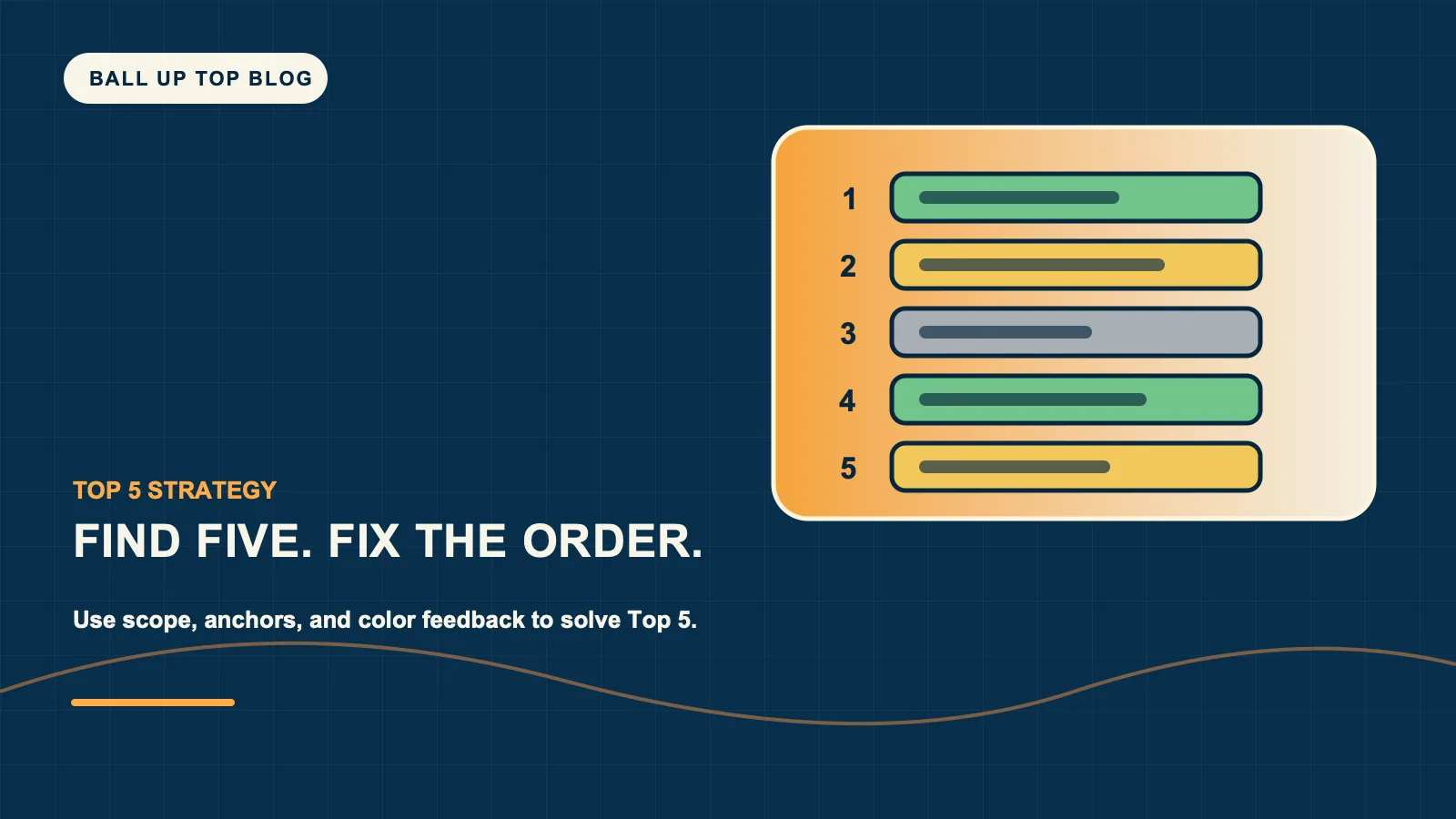
In a roster-identification game, treat each clue as evidence that updates one working hypothesis. Conference, position, career stops, honors, and time period should agree with the same person. Do not force a favorite answer to survive a contradictory clue. In a ranking game, identify the category and endpoints first, then place the most certain items before resolving the middle. These habits are useful across basketball questions because they separate recall from decision-making.
When you miss, record the relationship rather than only the answer. ‘Player X won an award’ is less reusable than ‘Player X won this award in this season while playing for this franchise.’ A short note that includes the clue type, the mistaken assumption, and the corrected connection builds a better memory cue. Over time, repeated misses reveal whether you need more work on franchise history, chronology, awards, transactions, or player identification.
Choose a Ball Up Top format
Crossover is a natural fit for fans who enjoy finding players at the intersection of two basketball categories. Rosters turns a sequence of verified clues into an identification problem. Top 5 asks you to order a set around a stated basketball category. Each format tests a different skill, so switching among them can expose whether your strength is broad association, clue-by-clue deduction, or comparative ordering.
Ball Up Top also includes multi-sport formats, so an NBA subject can appear alongside knowledge from other leagues. Read the prompt and category labels before assuming a basketball interpretation. Grid Iron is a nine-question sports trivia board, and its name does not limit its subject matter to one sport. Daily selections can reward flexible recall across basketball and the rest of the sports world.
A productive session can be simple: play one puzzle, review one uncertain answer, and follow one connection into a guide. Consistency matters more than cramming. The goal of this hub is not to predict a current season. It is to help you build durable basketball context that remains useful when teams change lineups and new chapters are added to league history.