
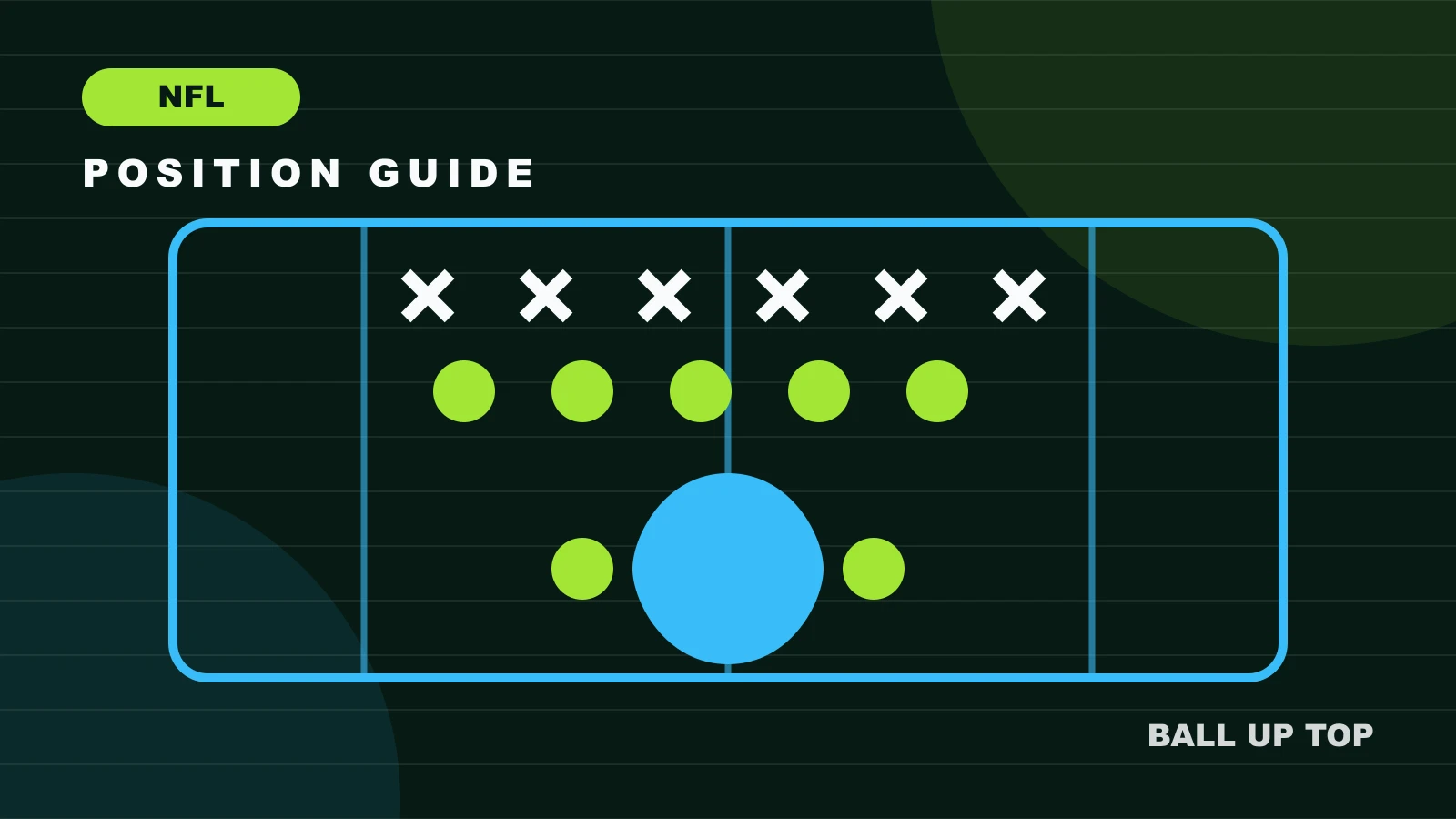
NFL positions are easiest to understand by splitting a team into three units: offense tries to advance the ball and score, defense tries to stop that advance or take possession, and special teams handles kicking plays and returns. Each unit can use 11 players at a time, but coaches change the mix of positions to fit the situation.
NFL positions at a glance
| Unit | Main position groups | Primary purpose |
|---|---|---|
| Offense | Quarterback, running back, wide receiver, tight end, offensive line | Move the ball and score |
| Defense | Defensive line, linebacker, cornerback, safety | Stop the offense and create turnovers |
| Special teams | Kicker, punter, long snapper, holder, returner, coverage and return blockers | Handle kickoffs, punts, field goals and extra points |
A position describes a player's usual role, not a spot where that player must remain for the entire play. Offenses shift receivers and tight ends before the snap, defenders disguise coverage or pressure, and special-teams contributors often have another listed position.
Offensive positions explained
The offense begins a play in possession of the ball. Its formation must follow NFL alignment rules, but the skill-position players around the offensive line can appear in many combinations.
Quarterback (QB)
The quarterback usually receives the snap from the center and directs the offense. Depending on the play, the QB may hand off, throw, run, change the protection, or adjust the call before the snap. The quarterback touches the ball on most offensive snaps, but every play depends on timing and protection from the rest of the unit.
Running back (RB) and fullback (FB)
A running back carries the ball, catches passes and helps in pass protection. A fullback is generally a larger back used as a lead blocker, short-yardage runner or receiver. Many teams use a tight end or an additional wide receiver instead of a fullback, so “backfield” describes an alignment more reliably than one fixed personnel package.
Wide receiver (WR)
Wide receivers create space by running pass routes. They may line up near the sideline, in the slot between the outside receiver and offensive line, or move across the formation. Speed helps, but route precision, hands, body control and blocking also matter. “Slot receiver” is usually a role or alignment, not a separate official position.
Tight end (TE)
A tight end combines receiving and blocking responsibilities. The player may align beside an offensive tackle, in the slot, out wide or behind the line. That versatility lets an offense change its look without substituting.
Offensive line: center, guards and tackles
Five offensive linemen form the core protection group:
- Center (C): snaps the ball and often helps identify blocking assignments.
- Guards (G): line up on either side of the center and block in the interior.
- Tackles (T): line up outside the guards and protect the edges.
Linemen open rushing lanes and protect the passer. On a normal forward pass, they are generally ineligible receivers, while eligible players must satisfy formation and numbering rules. “Left” and “right” identify the side of the formation; they do not mean the two jobs are always identical.
Defensive positions explained
The defense can use different fronts, coverages and pressure packages, which is why one defender may be labeled differently across teams or eras.
Defensive line: tackle, nose tackle and end
Defensive linemen start closest to the ball. A defensive tackle (DT) attacks the interior, occupies blockers and closes running lanes. A nose tackle (NT) typically aligns over or near the center in fronts that call for a powerful middle anchor. A defensive end (DE) aligns toward the edge, where the job may include containing the run and pressuring the quarterback.
Linebacker (LB)
Linebackers operate behind or alongside the defensive line. Inside or middle linebackers commonly diagnose runs, cover short zones and communicate adjustments. Outside linebackers may cover, defend the edge or rush the passer. Terms such as MIKE, WILL and SAM identify assignments within some systems; they are not universal promises about where a player will stand.
Cornerback (CB)
Cornerbacks usually cover wide receivers and defend the outside portions of the field. They may play tight man coverage, drop into a zone or blitz. A nickel corner enters when the defense adds a fifth defensive back, often to match a slot receiver. “Nickel” describes the package and role, not a fifth base position group.
Safety (S)
Safeties usually align farther from the line than cornerbacks, but their duties vary. A free safety often protects deep space and reads the quarterback. A strong safety may align closer to the line, cover a tight end or support the run. Modern defenses blur that distinction, so scheme context can be more informative than the label alone.
Edge rusher and defensive back
Two umbrella terms appear often:
- Edge rusher: a defender whose primary job is to attack from the outside. The player may be listed as a defensive end or outside linebacker.
- Defensive back (DB): any cornerback or safety; nickel and dime defenders also belong to this group.
These labels explain function when a traditional roster designation does not tell the full story.
Special-teams positions explained
Special teams takes the field for kickoffs, punts, field-goal attempts and extra-point attempts. It includes specialists plus blockers, coverage players and returners.
- Kicker (K): handles field goals, extra points and usually kickoffs.
- Punter (P): kicks on punt plays to trade possession for field position.
- Long snapper (LS): delivers the longer, precise snap used on punts and placekicks.
- Holder: catches the snap and places the ball for a field goal or extra point; a punter or backup quarterback often fills the role.
- Returner: fields kickoffs or punts and tries to gain yardage while protecting possession.
- Coverage and return units: block, pursue, contain lanes and make tackles. Many participants are reserve receivers, running backs, linebackers or defensive backs.
Special teams is not simply the kicker and punter. A clean snap, sound protection, disciplined coverage and a secure catch can decide field position—or a game.
Why position labels change by formation
You may hear “11 personnel,” “nickel defense” or “dime package.” These terms describe the group on the field:
- 11 personnel: one running back and one tight end; the remaining eligible skill players are usually three wide receivers.
- Nickel defense: five defensive backs.
- Dime defense: six defensive backs.
The names do not reveal the entire play. The same personnel can line up in multiple formations, and a defense can rush or cover from the same pre-snap look. Think of personnel as the cast and formation as where that cast begins the scene.
How positions help you follow games and solve trivia
Position knowledge gives every play a map. Watch the center to find the snap, the tackles to see the pocket edges, the linebackers to read run fits and short coverage, and the safeties to understand deep help. On kicking plays, follow the snap-to-kick operation before tracking the return.
It also turns broad NFL clues into useful filters. If a clue identifies a tight end, edge rusher or return specialist, you can narrow the candidate pool before considering teams, eras or awards. Explore more league context in the NFL hub, then see how progressive clues work in How to Play Rosters. For a stronger recall routine, try How to Get Better at Sports Trivia.
Quick FAQ
How many NFL positions are there?
There is no single official total because broad groups split into roles and scheme-specific labels. The clearest starting point is offense, defense and special teams, then the position groups listed above.
Can one NFL player have more than one position?
Yes. A player may have one roster designation but perform several roles, and many reserves also play on special teams. Hybrid defenders are especially likely to be described by function as well as listed position.
What is the difference between a formation and a position?
A position is a player's role. A formation is the way players align before the snap. The same set of positions can create several formations.
Once the map makes sense, put it to use across today's sports puzzles. Play Ball Up Top.